
“Proud despite my misery, I revolted: I took [Professor Gastaldi] by his jacket and pushed him against the wall . . . ”
“Note Well: A Very Bad Student” –This notation, handwritten by Professor Gastaldi, appears next to Tommaso Juglaris’s name in the registrar’s records at the Accademia Albertina.
“Returning to my miserable studio I found a letter from Lanslebourg, Savoia [from a] painter I had known painting the ceiling of a salon in Via Cernaja . . . He invited me to leave for Lanslebourg immediately where he had a church to decorate. I had my passport made . . . and departed . . . I worked for nearly three months…was paid handsome, treated like a lord. I was given a lovely declaration of their full satisfaction, signed even by the mayor. I returned to Turin with about 1000 lire in my pocket. I could breathe. I then believed myself to be an artist too.”
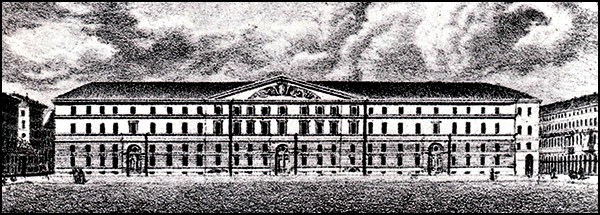
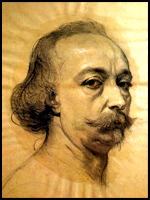
The personal words of King Vittorio Emmanuele II on the scaffolding in the royal palace, encouraging further studies, were not lost on the young Juglaris. With the vision of formal training at an art academy still his ideal, Juglaris made one last attempt to complete art studies leading to a diploma or degree. He returned to night classes at the Albertina Academia. Yet, despite his daytime employment, he still had little money to spare. His need for thrift forced him to paint on used canvases. When his esteemed professor, the aristocratic Andrea Gastaldi, loudly insulted him for this, Juglaris exploded and had to be restrained. As he recounted the climactic moment in his own memoirs: “Proud despite my misery, I revolted: I took [Professor Gastaldi] by his jacket and pushed him against the wall…” It was an awful moment for professor and student alike, who each saw their honor at stake. Professor Gastaldi was harsh and unforgiving as he offered his own final word on the whole incident that ended Juglaris’s academic career. In registrar records preserved at the Accademia Albertina and still available for inspection, Gastaldi entered a handwritten remark next to Juglaris’s name: “Nota Bene [Note Well]: A very bad student.”
With the Accademia’s doors closed behind him and no diploma in hand, Juglaris was all the more determined to seek whatever profitable work might be available in his greater quest to fulfill his calling as a decorative artist and muralist. He took special pride in sets completed for the Royal Theater of Turin, where he was keenly appreciated for his fine figural work. At the same time, Juglaris set his sights higher, dreaming of a more complete and fulfilling career in both the decorative and fine arts. Offering a foretaste of what might become more widely possible, Juglaris received an unexpected and most encouraging invitation to paint a series of murals for a parish church in Lanslebourg, France, an alpine town in French Savoy across the border from Italy. As Juglaris’s memoirs recall with great satisfaction:
“Returning to my miserable studio I found a letter from Lanslebourg, Savoia [from a] painter I had known painting the ceiling of a salon in [Turin’s] Via Cernaja… He invited me to leave for Lanslebourg immediately where he had a church to decorate. I had my passport made…and departed… I worked for nearly three months…was paid handsome, treated like a lord. I was given a lovely declaration of their full satisfaction, signed even by the mayor. I returned to Turin with about 1000 lire in my pocket. I could breathe. I then believed myself to be an artist too.”
The commissioned work at the Lanslebourg church buoyed Juglais’s confidence immensely. As it subsequently turned out, it was not to be the last time that Juglaris ventured to France to advance his vocation and career.