“Many times I tried to imitate American painting but it was not possible for me. It was without style and without method.”
“The blood rushed to my head, I conquered the anger that overtook me and after a minute replied to Prang that . . . I accepted only the civic code of the United States, I spit upon the others, and that neither Prang nor anyone else would have obliged me . . . to the laws of slavery.”
As Tommaso Juglaris adjusted to Boston life, he received an invitation that seemed to offer a promising entrée into the city’s highest cultural circles. The Boston Museum of Fine Arts was organizing an “Exhibition of Works by Living American Artists,” for November 9 through December 20, 1880. Juglaris was asked to lend to the show his two award-winning Paris Salon paintings, Paolo Veronese in Venice also known as Venetian Promenade) and The Invasion. The exhibition roster was choice and, except for two German-born artists, Otto Grundmann and Ignaz Gaugengigl, very American. Indeed, the other artists to be represented in the exhibition were already prominent and daily gaining more attention across the United States. They included Helena de Kay Gilder, Will H. Low, Francis “Frank” Millet, Ernest Longfellow, William Merritt Chase, Sarah W. Whitman, George Inness, J. Alden Weir, Frank Crowninshield, Charles Dana, Emily Sartain, William Sartain, and Maria Oakey (Dewing). After only nine weeks on American shores, it must have been very flattering to Juglaris to be included in such company and deemed a “living American artist.”
Taking note of Juglaris’s two Paris Salon paintings, the art critic for the Boston Evening Telegraph in attendance at the “Living American Artists” Exhibition was generally laudatory, while possibly revealing some ambivalence about the nudity so conspicuous in The Invasion. As he remarked: “Of grand compositions there are two great canvases bearing the unfamiliar name of Thomas Juglaris, whom the catalogue puts down as a Boston painter born in Italy, one a Venetian water painting, brave in Venetian colors and figures almost life-size and the other an ideal picture of a prehistoric man and his wife ad child at the door of his cave dwelling alarmed at the camp-fire of some migrating horde invading the valley below. The Eve-like costumes of the period gives opportunity for some admirable flesh-painting, [and] the drawing is strong, and the subject truly grand and inspiring in conception, if not the highest artistic taste in the carrying out.” (“The Exhibition: Works of Living American Artists at the Museum,” Boston Evening Telegraph, November 13, 1880, 4)

Attending the Boston Museum exhibition, as recounted in Juglaris’s personal memoir, was the already established and well-connected American artist Francis Davis Millet. Like Juglaris, Millet had been a student of both Alexandre Cabanel and Thomas Couture in France. Consequently, Juglaris and Millet were already acquainted. However, Millet—perhaps feeling competitive with regard to his own credentials, talents, and partiality to mural work as exemplified by his recent commission at Trinity Church adjoining the Boston Museum--had cold-shouldered Juglaris since his August 1880 arrival in Boston. At the exhibition opening, there was an unpleasant moment when Juglaris pointedly confronted Millet about such rank discourtesy. Whatever relationship they had shared abroad was never to be renewed in America.
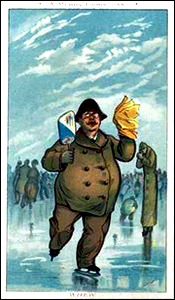
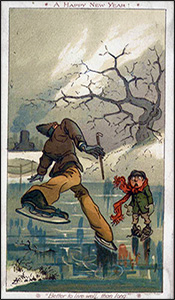
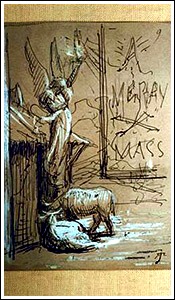
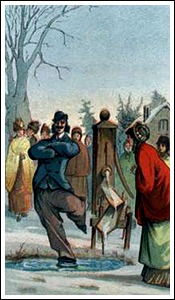
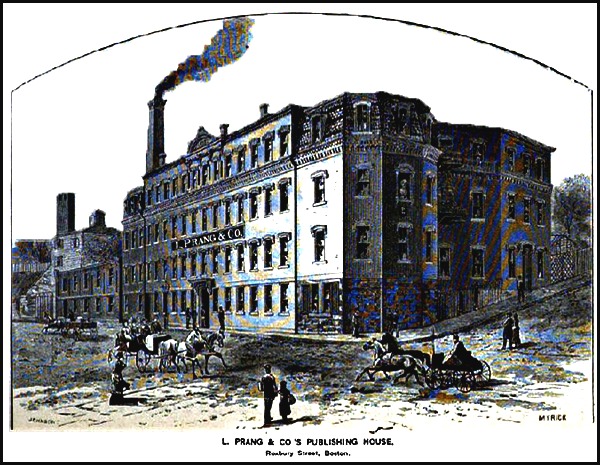
Unfortunately, matters were not exactly sanguine and bright for Juglaris at Louis Prang And Company either. In Juglaris’s first weeks at the Prang firm, circumstances took an unexpected turn. Prang quickly proved to be a tyrannical employer. He not only reneged on details of Juglaris’s employment contract but also made other demands on his time and talent, including an imperious request for a portrait. Meanwhile, he brusquely challenged Juglaris’s right to exhibit his Paris Salon paintings at the Boston Museum exhibition. Prang insisted that he “owned” Juglaris and was fully entitled to control his creative activities, even outside of working hours. Adding insult to injury, Prang complained that Juglaris’s art style was “too French” to suit American tastes and that he needed a period of apprenticeship to learn a different style. In vain, Juglaris protested that the most respected American painters had received their training in France or Italy. Defiant, Juglaris exhibited his works at the Boston Museum anyway. After this, he and Prang avoided each other.
The souring of the relations with his employer perplexed and demoralized Juglaris. Although he could not have known it at the time, even native-born artists, as historian Michael Clapper has documented, also had their difficulties with the hard, exploitive dealings of Louis Prang. To make up for slashed pay and to keep food on the table, Juglaris took on students. Since there were still months on his half-year contract with Prang, he had to bid time until he was free to do anything else. When the employment agreement finally expired, an angry Prang openly vowed that Juglaris would never work in Boston again.