
"Is there not a prima facie case against the Italians? ...Is not every Italian who descends shipboard...a menace to our industrial interests?" —Boston Daily Advertiser, April 10, 1882
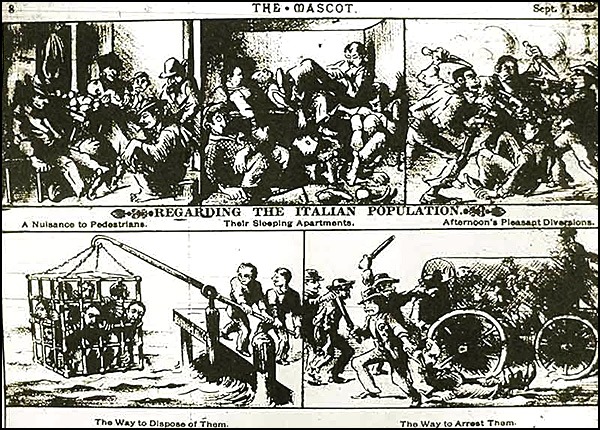
As Tommaso Juglaris continued to pursue his career in Boston, he encountered, as an Italian immigrant, divergent attitudes. On the one hand, more cosmopolitan Bostonians valued his presence and what he could add to the city’s art life. This was actually reinforced by publicly expressed sentiments offered in conjunction with the city’s “Grand Foreign Exhibition” opening at the New England Manufacturer’s and Mechanics’ Institute Building on Huntington and West Newton Avenues on September 3, 1883. The Official Exhibition Catalogue not only featured an admiring account of a unified Italy, illustrated with portraits of King Umberto I and Queen Margherita. It also included editorial comment which seemed to be written with those like Juglaris in mind. As the Catalogue declared:

“We esteem it a fortunate turn of events in our favor that Italian artists are overcoming their dislike of leaving their homes and daily avocations, and may be induced to come to Boston; and that not alone in pictures will they compete with the world in this display of taste and skill, but in the arts which Benvenuto Cellini in the sixteenth century loved to exercise, in addition to his larger work as a sculptor—‘the decoration of cups and salvers, ornamental sword and dagger hilts, clasps, medals and coins; displaying great skill in composition and excellence in execution.”
Underscored was the way that Italian artists and artisans could positively contribute to the local quality of both the fine and industrial arts, which was especially important as Boston competed with New York City for cultural preeminence.
On the other hand, there was, as Juglaris personally experienced through offhand remarks and slights, a rife prejudice against Italian immigrants. It palpably increased throughout the 1880s as more Italians arrived on American shores, settling in Boston, as well as other cities.
The objection to Italian immigration was multi-fold. There was rampant concern that Italian immigrants would not be able to meld with a white, Anglo-Saxon Protestant American culture because of different cultural values, engrained temperament, limited education, and an overarching fealty to the Pope and Roman Catholicism. Because they were willing to work for lower wages, Italians were also seen as a threat to the security and well-being of more well-established America laborers.
The Italian community did push back against rank prejudice. To this end, seeking to legitimize their own settled presence in the United States, Italian Americans invoked in their communal life the compelling image of Genoa-born Christopher Columbus—or Christoforo Colombo—whose original “New World” encounter had the set the stage for all European immigration to the Americas. Indeed, by 1876, four years before Juglaris’s own arrival to the continent, there were already annual Columbus Day celebrations sponsored by the Italian communities of Boston, St. Louis, Cincinnati, and New Orleans. This was to culminate in the one-time proclamation of a National Columbus Day celebration on October 12, 1892, as legislated by Congress and issued by the White House upon signature by President Benjamin Harrison. Moreover, the following year, the United States hosted the World Colombian Exposition in Chicago where Juglaris would exhibit one of his paintings in the Italian Pavilion. Yet none of this, early or later, was enough to stem the tide of virulent hate mongering and discrimination towards Italian immigrants.
Resentment towards immigration by Italians and other southern or eastern Europeans could rear its head in surprising quarters. For example, the late nineteenth-century feminist and suffragist Olympia Brown, who was one of America’s first women to be ordained for ministry by a national denomination and a very popular speaker in enlightened Boston circles, considered it unfair that less-educated, newly-minted American, albeit men, could receive all the privileges of citizenship, including the right to vote, denied to educated, native-born women. The Reverend Brown joined labor leaders and fellow Protestant clergy in condemning immigration from Italy and elsewhere as a “menacing eruption” that was subversive to American democracy and its established institutions. In an address entitled On the Foreign Menace (1889) Brown vehemently declared: “…there are in the United States three times as many American-born women as the whole foreign population, men and women together, so that the vote of women will eventually be the only means of overcoming this foreign influence and maintaining our free institutions. There is no possible safety for our free school, our free church or our republican government unless women are given the suffrage and that right speedily.”
Of course, as underscored in another context by gender scholar Joan Wallach Scott in her history, Sex and Secularism, Olympia Brown would not be the last women’s rights activist to register frustration over the exclusion of women from the political franchise so readily enjoyed by men deemed less worthy for lack of education and acculturation, like those recently immigrating from Italy’s shores. Across the Atlantic on the European continent, the leading French suffragette Hubertine Auclert bitterly complained that ‘the denial of the vote to ‘cultivated white women’ while it was granted to ‘savage blacks’ undermined the [French Republic’s] secular mission.”
Back in Boston, expressing consternation about Eastern and Southern European immigration from yet another angle was Massachusetts Institute of Technology professor Francis Amasa Walker. As noted by historian Laura K. Lovett, Walker, head of the U.S. Census for 1870 and 1880, contended that the slovenly ways and “vastly lower standard of living” of huge “throngs of brutalized peasantry”—now crude immigrants to American shores--was forcing “our [native-born] people to look upon houses that were mere shells for human habitations, the gate unhung, the shutters flapping and falling, green pools in the yard, babes and young children running about half naked or worse, neglected, dirty, unkempt.” The shock and revulsion felt towards such sights, particularly distressing to more refined sensibilities, was depressing the native American (i.e. Anglo-Saxon) birthrate across the United States, precipitating the prospect of “race” decline—soon to be termed “race suicide.”
Further compounding such rancorous animosity greeting Italian immigrants were pernicious, full-throated racial blood theories that had already enjoyed wide currency in ante-bellum and post-Civil War America. Besides rationalizing earlier slavery and justifying the Jim Crow laws which followed emancipation for African Americans, these racial blood theories, associating intelligence deficits and moral degeneracy with darker race people, also spurred deep hostility towards Southern Italians arriving on America’s shores who were presumed to share African blood as part of their Mediterranean heritage.
Ironically, two major propagators of such racial theorizing, fostering the late nineteenth and early twentieth century pseudo-science of eugenics, had intimate ties Tommaso Juglaris’s own Italian home city, Turin. Indeed, diplomat, novelist, and racial theorist Count Arthur de Gobineau (1816-1882) spent his last days in the former royal Savoy capital. Best known for An Essay on the Inequality of the Human Races (1853), de Gobineau contended that Southern Italians were racially inferior to Northern Italians, who had more Nordic blood. Likewise, Cesare Lombroso (1835-1909), the so-called “Father of Modern Criminology,” served as professor of psychiatry, forensic medicine, and criminal anthropology at the University of Turin. Through multiple published works, which gained a substantial audience in the United States, Lombroso disseminated the idea that criminality was a genetically inheritable condition often discernible from physical type and appearance. Along with Walker and de Gobineau, Lombroso’s writings inevitably encouraged ethnic profiling which, beyond stigmatizing Southern Italian immigrants, was making all emigres from the Kingdom of Italy objects of suspicion.