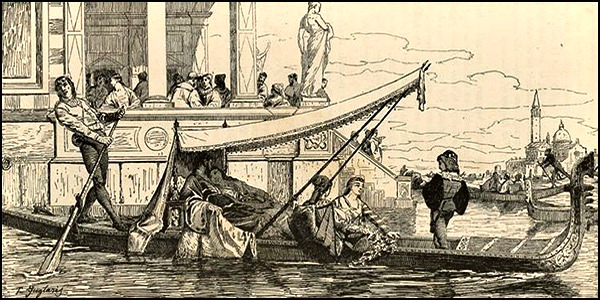
Published sketch of Juglaris's honored Paris Salon painting, Paolo Veronese in Venice, also titled Venetian Promenade.
In order to maintain his foothold in the fine arts and keep both eye and hand in practice, Juglaris accepted numerous portrait commissions. This work suited his frugality as well: the willingness of patrons to voluntarily sit for him eliminated the expense of hiring live models as he continued to hone his easel skills.
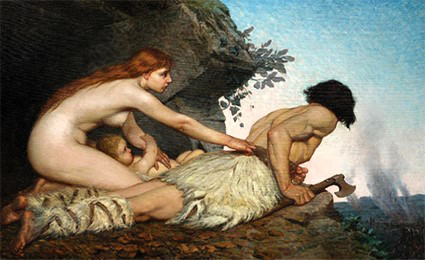
The Invasion, Tommaso Juglaris's 1880 Paris Salon painting Photo: Giangiorgio Massara
Despite his constant complaint that “my work in industrial art took all my time,” Juglaris nonetheless began exhibiting regularly at the famous Paris Salon. This annual juried art exhibition, sponsored by the French government, served as a proving ground for fine artists. Among his Salon paintings were Offering to the God Lares, The Confidence, Paolo Veronese in Venice
(also known as Venetian Promenade), and The Invasion, all exhibited between 1873 and 1880.
Vaguely reminiscent of a genre painting by Italian compatriot and Accademia Albertina instructor Enrico Gamba, entitled Carlo Goldoni Seeking Inspiration from Life (Goldoni a Venezia - 1872), Juglaris’s Paolo Veronese painting sought to commemorate the “active and even pleasure-loving life one of the great masters of the Renaissance.” It received considerable public attention, earning Juglaris his third “Honorable Mention” at the Paris Salon and granting him the privilege of submitting future paintings to the Salon without advance juried review. Juglaris’s chosen subject-matter reflected revived interest in Veronese and the “Venetian School” on the part of such late 19th century writers as Theophile Gautier, John Ruskin, Water Pater, Dante Gabriel Rossetti, and Edward Burne Jones.”
In these same heady years, however, Juglaris’s Invasion also drew the favorable notice of critics. A photographic image of Juglaris’s latest work, depicting a barbarian family sheltering before a rock outcropping in the face of a not-so-distant advancing, marauding army, was published in Parisian newspaper coverage of the Salon, as well as featured in the Paris Salon’s 1880 illustrated catalogue edited by Francois-Guilliaume Dumas. Although not as large as Paolo Veronese in Venice, The Invasion is an amply sized work commanding attention. In the words of the contemporary art dealer Gautier Genderbien, it was intended as a “virtuoso work of total commitment capable of striking at the heart of the public and critics alike.” The result was indeed an “impeccably composed and drawn work of utmost solidity, enhanced by a confident, taut, and vibrant style of painting that is both robust and refined.”
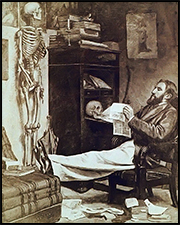
The Scholar, Salon painting by Juglaris
Meanwhile, amid such Paris Salon successes, Juglaris received various commissions for decorative and mural work at the Palais Garnier Opera House, the Palais Gioia, and the
Theatre du Chatelet--all in Paris.
Both the Palais Garnier and the Theatre du Chatelet are Paris landmarks.
Indeed, in the words of architectural historian David A. Hanser the Palais
Garnier, which opened in 1875, is “probably the most famous opera house in
the world, a symbol of Paris like Notre Dame Cathedral, the Louvre, or the
Sacre Coeur Basilica.” It provided the setting for Gaston Leroux’s popular
novel The Phantom of the Opera (1910). Likewise, the Theatre du
Chatelet is another famous Paris performance center, serving as the original
venue for the Ballet Russes and the premiere of major ballets and symphonic
works by Igor Stravinsky, Maurice Ravel, Claude Debussy, and Erik Satie.
In 1876, Juglaris also won a competition to decorate a civic theater at a newly-constructed Mechanics Institute in Barnsley, England, north of Leeds. Glad to seize the day, he traveled to England (despite his almost complete ignorance of English) to undertake the commission. After months of Herculean effort, his decorations were unveiled to considerable acclaim. At the ball celebrating the theater’s official dedication, he was immensely gratified by the sign put up by his hosts:
“Honor to the painter Juglaris.”